
The short version
One name. More than one Rider.
Ghost Rider is best understood as a lineage. Johnny Blaze established the flaming skull and infernal motorcycle; Danny Ketch rebuilt the idea for the 1990s; Robbie Reyes proved that even the vehicle, setting and source of the haunting could change.
The visual promise is immediate: a human host becomes a blazing supernatural avenger and pursues the guilty. The details are less tidy. Different Riders have been bound to different spirits, demons or ghosts, and later stories have repeatedly revised how the Spirits of Vengeance fit into Marvel's wider mythology. That instability is part of the character's strength rather than a flaw.
Johnny remains the defining Ghost Rider, but Danny contributed much of the language modern readers recognise—the chain, black leather, transformed Hellcycle and Penance Stare. Robbie moved the concept to East Los Angeles and replaced the motorcycle with a demonic muscle car. Other branches, from Alejandra Jones to Cosmic Ghost Rider, show how far the central image can travel.
Follow the hosts and the vehicles, and Ghost Rider's history becomes a map of Marvel horror across five decades.
Creation and first appearances
Before the flaming skull, there was a Western Ghost Rider.
Marvel first used the Ghost Rider name for Carter Slade, a white-clad Western vigilante introduced in The Ghost Rider #1 in 1967. He was not a flaming-skulled Spirit of Vengeance. After Johnny Blaze had taken over the name, Marvel reprinted and later referred to Slade as Night Rider and then Phantom Rider to distinguish the two concepts.
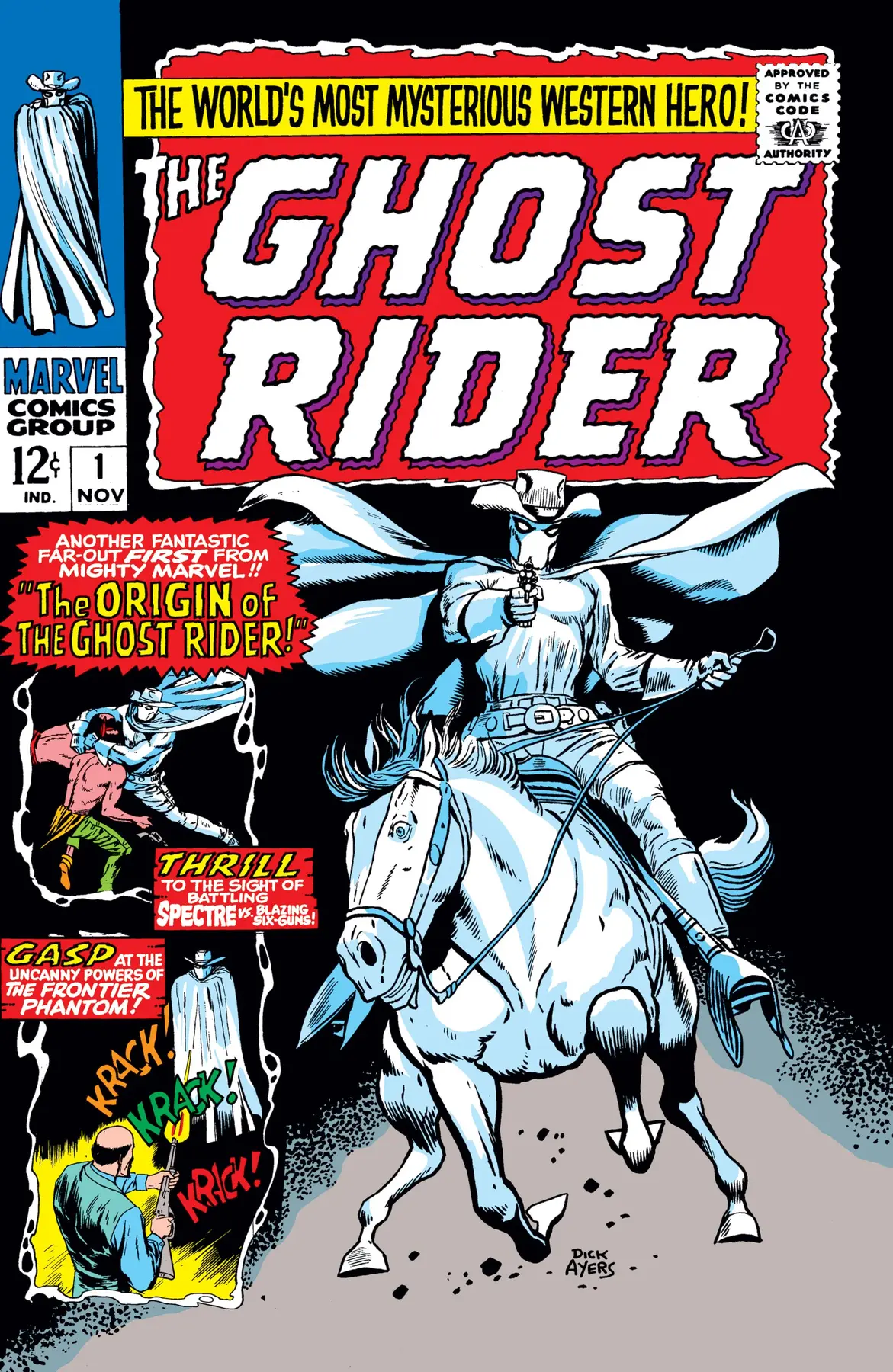
Marvel's first use of the name belongs to a spectral Western hero rather than the later motorcycle rider.

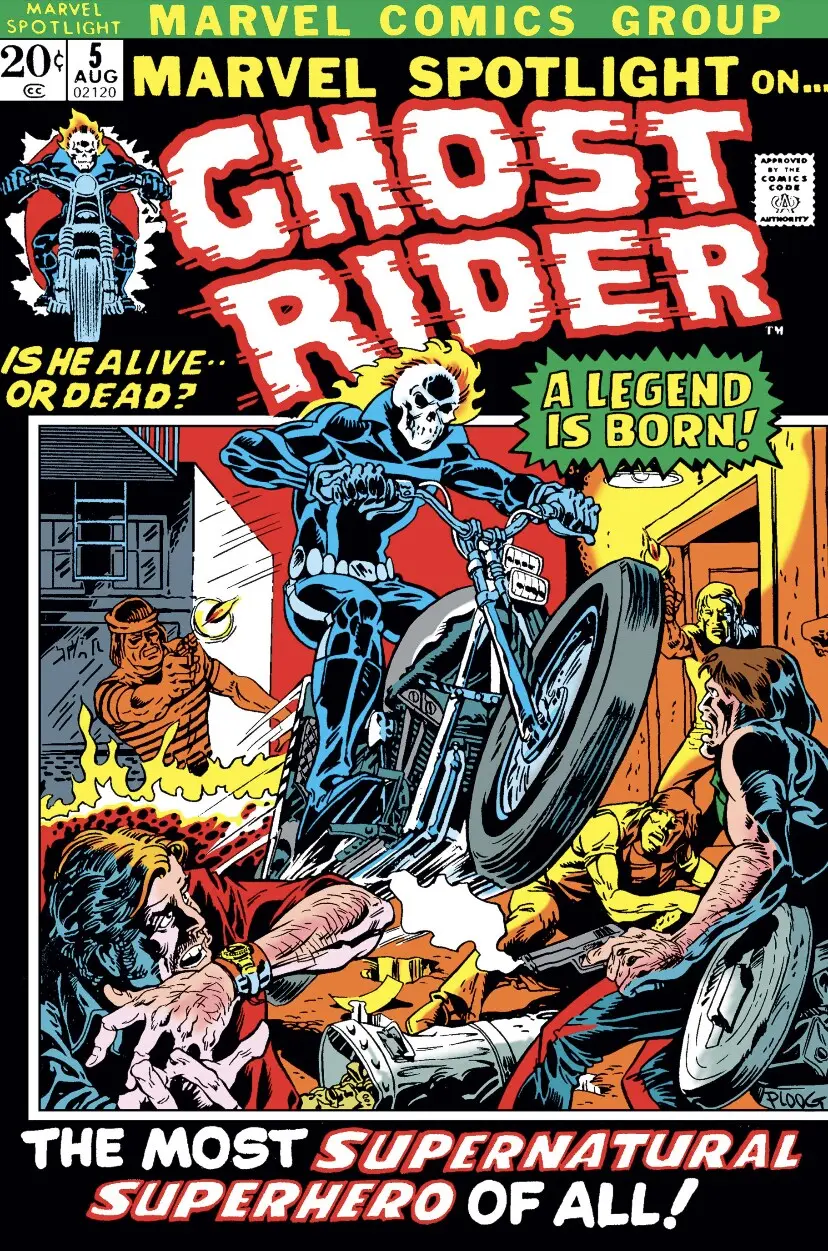
Johnny Blaze, the flaming skull and the motorcycle arrive together in the defining supernatural debut.
Johnny Blaze began as a motorcycle stunt performer who made a desperate bargain to save his adoptive father. The deal bound him to a demonic presence and transformed him into Ghost Rider after dark. Gary Friedrich, Roy Thomas and Mike Ploog all played central roles in shaping the concept; their later accounts differed, so the fairest history treats the creation as shared rather than assigning it to one person.
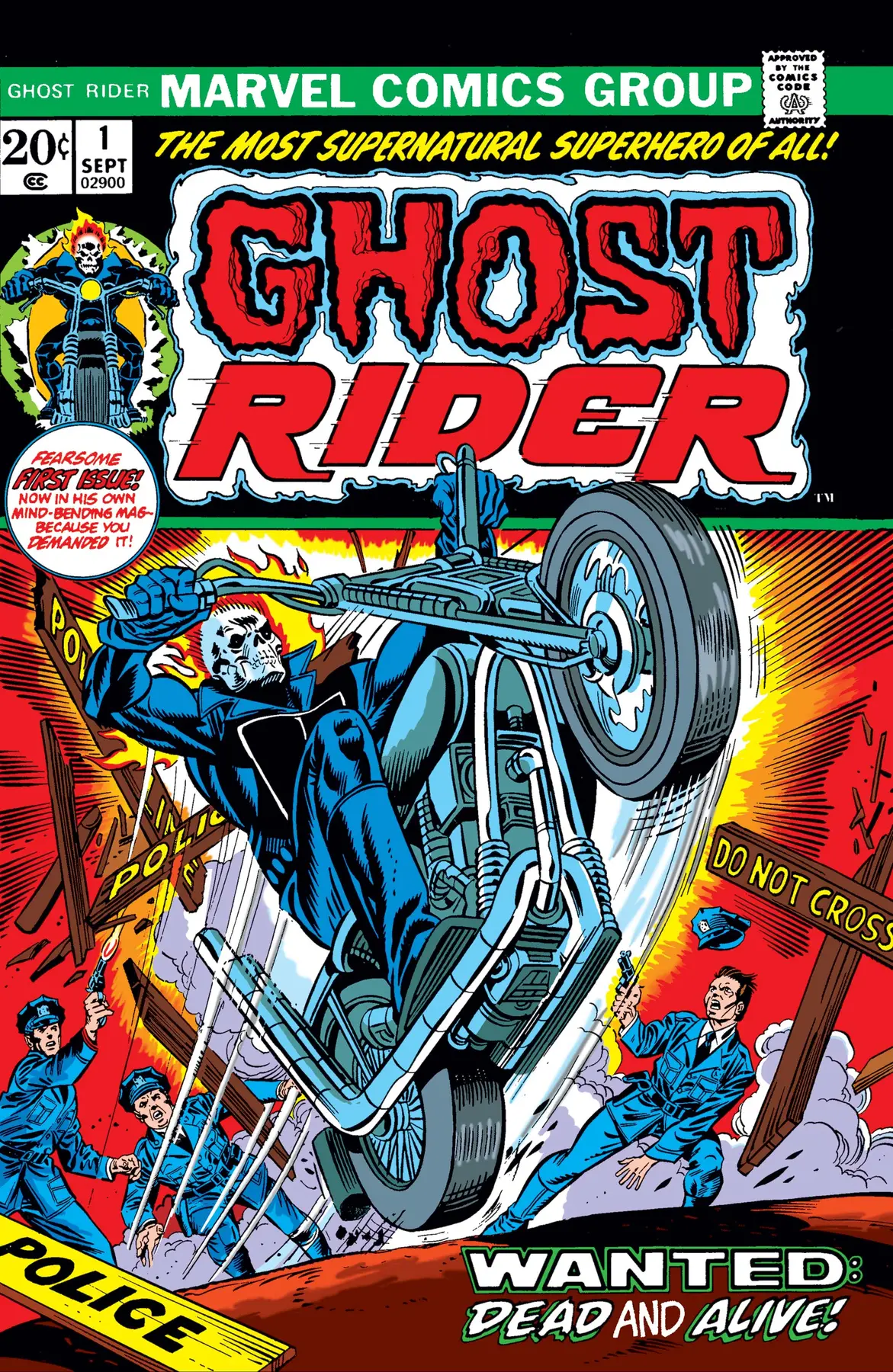
The feature ran through Marvel Spotlight #11 before moving into Ghost Rider #1 in 1973. That first Johnny Blaze self-titled ongoing series lasted 81 issues and gradually expanded a sharp origin story into a full road-horror mythology involving Zarathos, Mephisto and a long trail of supernatural encounters.

The Marvel Spotlight feature becomes a long-running solo title.

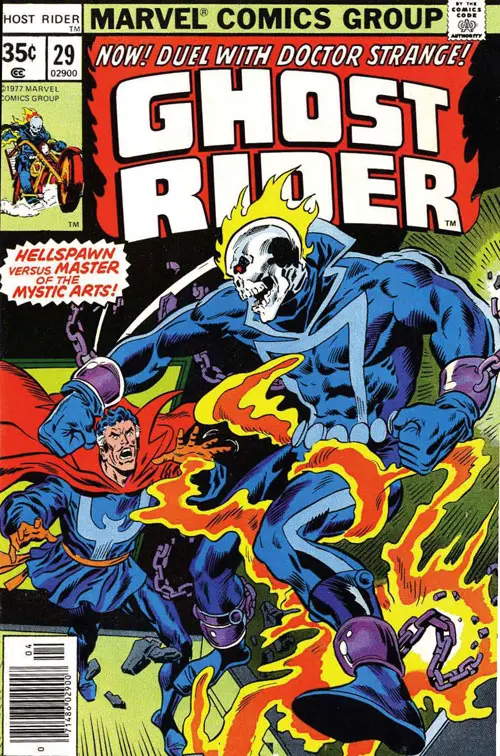
Ghost Rider meets Doctor Strange as the Bronze Age series moves deeper into Marvel's supernatural world.
Publication chronology
The Ghost Rider timeline.
Start at the top and follow the road down. This is the central publication story—how a Western name became Johnny Blaze's curse, then a legacy carried by Danny Ketch, Alejandra Jones, Robbie Reyes and stranger offshoots.
-
The name
The Ghost Rider #1 Carter SladeA Western ghost rides first.
Marvel's original Ghost Rider is a masked Western vigilante styled as a spectral gunslinger and descended from an earlier Magazine Enterprises concept. Carter Slade is publishing ancestry rather than the first motorcycle-riding Spirit of Vengeance.
Key reading · The Ghost Rider #1–7
-
The icon
Marvel Spotlight #5 Johnny BlazeThe flaming skull is born.
Motorcycle stunt rider Johnny Blaze bargains to save Crash Simpson and is bound to a demonic force. Gary Friedrich, Roy Thomas and Mike Ploog create the image that permanently redefines the Ghost Rider name.
Key reading · Marvel Spotlight #5–11
-
The first ongoing
Ghost Rider #1 · 1973 Johnny BlazeThe road opens into an 81-issue run.
The ongoing title adds a larger cast, deeper supernatural mythology and a short-lived place on the Champions. Don Perlin anchors much of the later run; Michael Fleisher writes its long middle stretch from #36 to #66, while J. M. DeMatteis drives the closing Zarathos arc.
Key reading · Ghost Rider #1–11 · #28–34 · #36–66 · #76–81
-
The rebirth

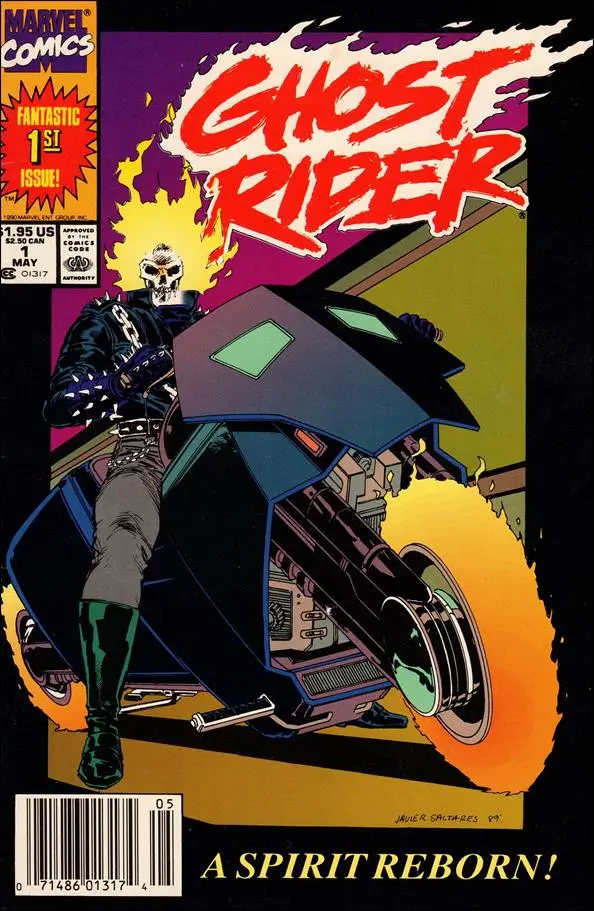
Ghost Rider #1 · 1990 Danny KetchA new Rider creates the modern vocabulary.
Danny Ketch touches a mysterious motorcycle and becomes a darker, armoured Ghost Rider. Howard Mackie, Javier Saltares and Mark Texeira establish the chain, transformed Hellcycle and Penance Stare that would shape the franchise for decades.
Key reading · Ghost Rider (1990) #1–25
-
The Midnight Sons

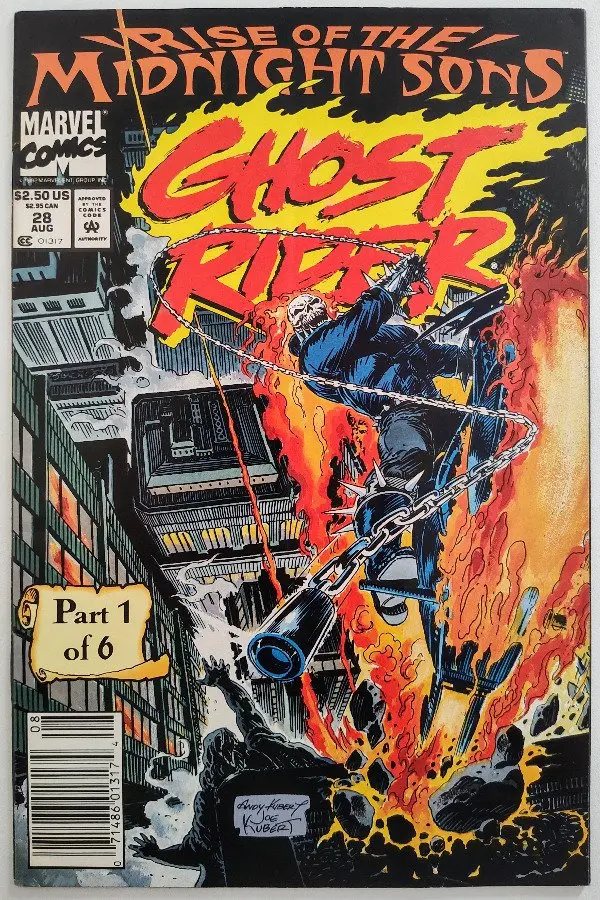
Ghost Rider #28 · 1992 Danny and JohnnyGhost Rider becomes the centre of a supernatural line.
Rise of the Midnight Sons links Ghost Rider, Blaze, Morbius, Nightstalkers and Darkhold. Johnny returns beside Danny, and the success of the Rider expands into Spirits of Vengeance and a chain of connected crossovers.
Key reading · Ghost Rider #28–31 · Spirits of Vengeance #1 onward
-
The return

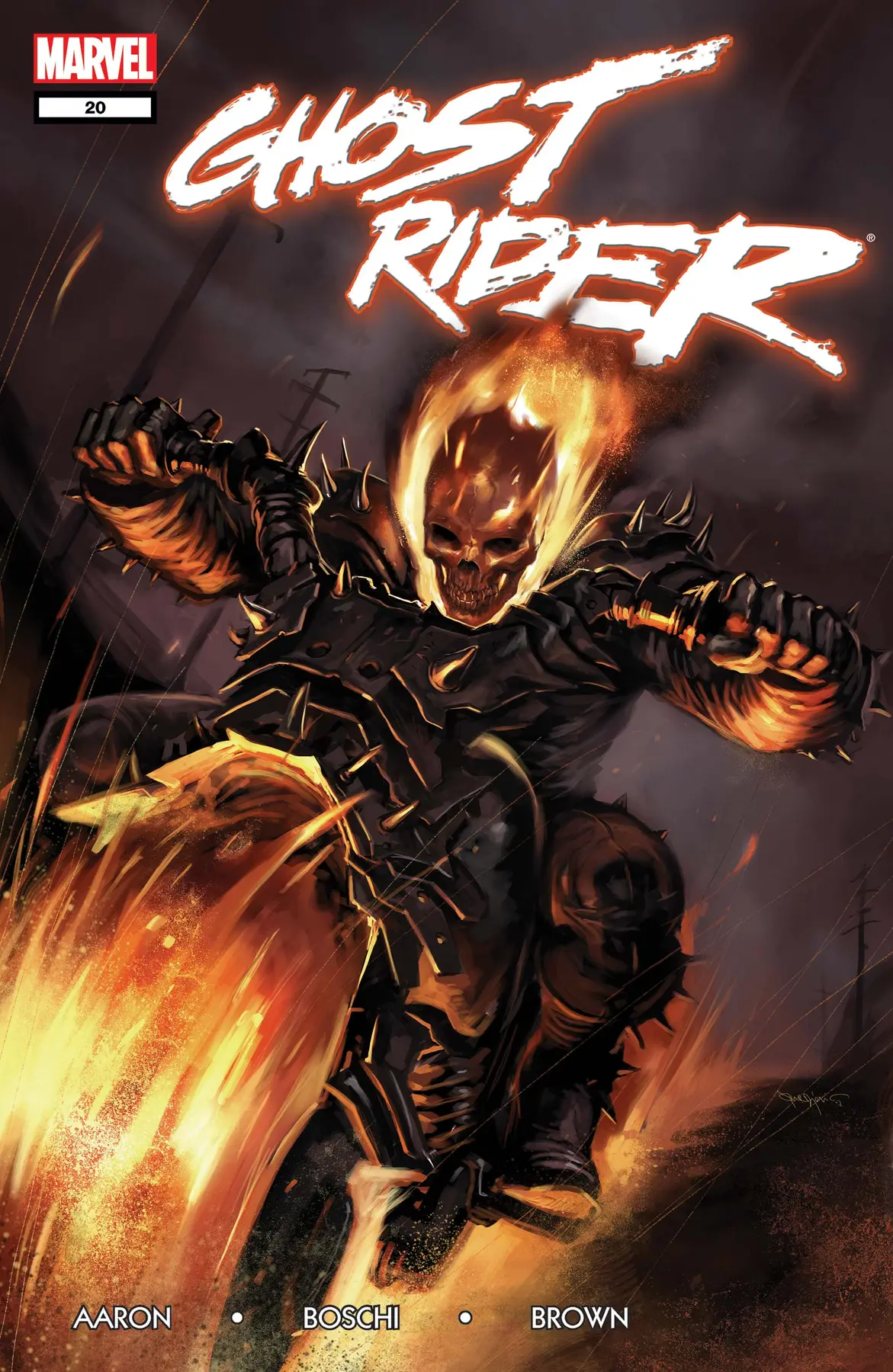
Ghost Rider #20 · 2008 Johnny BlazePrestige horror becomes a wider mythology.
Road to Damnation returns Johnny in painted infernal horror. Jason Aaron later takes over the ongoing title at issue #20 and imagines a worldwide history of Riders, ending his story in Heaven's on Fire.
Key reading · Road to Damnation #1–6 · Ghost Rider (2006) #20–35 · Heaven's on Fire
-
The new host

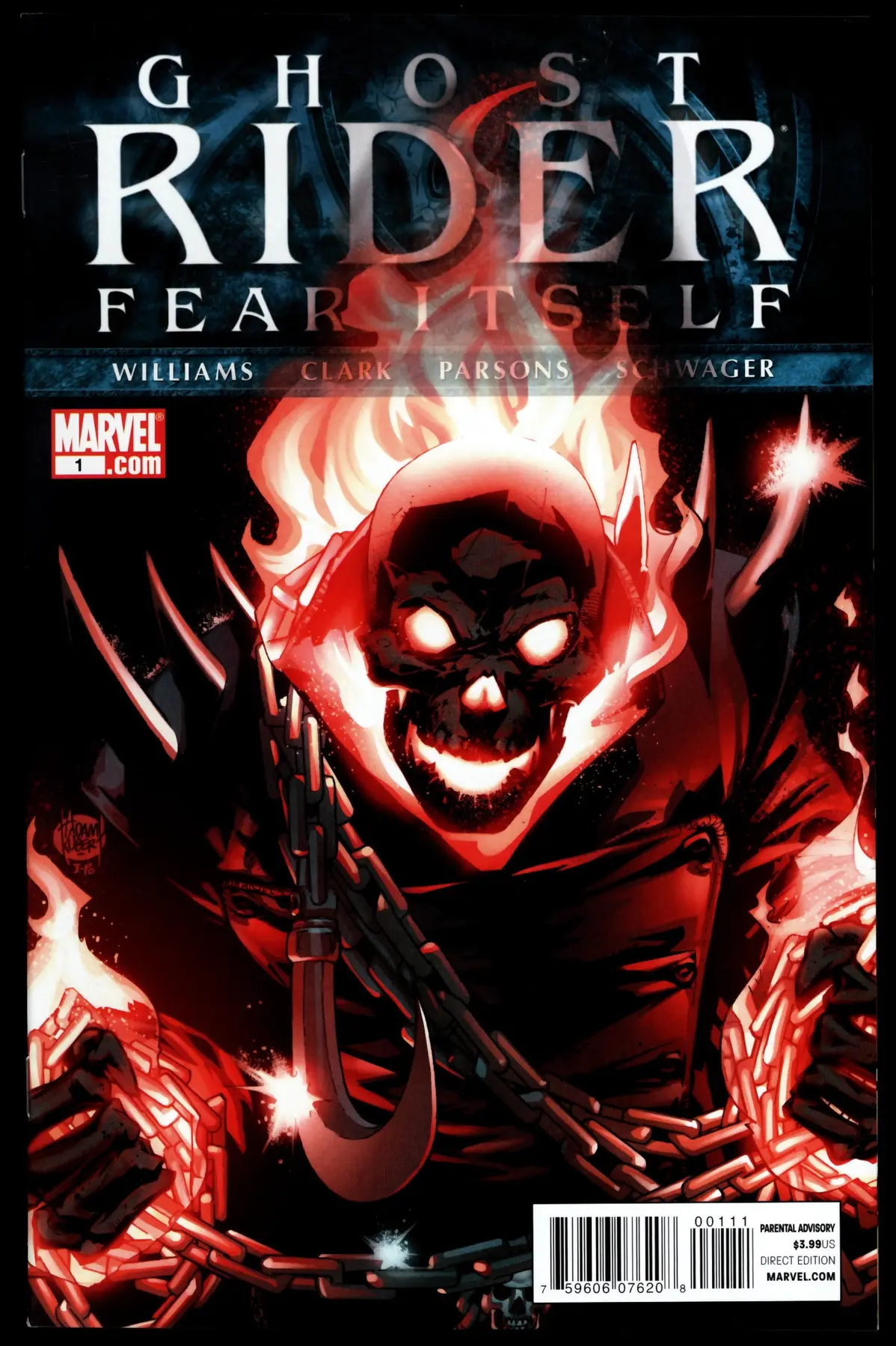
Ghost Rider #1 · 2011 Alejandra JonesThe mantle changes hands.
Alejandra becomes the new Ghost Rider under the manipulation of Adam, while Johnny tries to escape the curse. Her brief run overlaps with the Circle of Four crossover with Venom, Red Hulk and X-23.
Key reading · Ghost Rider (2011) #0.1 and #1–9 · Venom: Circle of Four
-
The reinvention

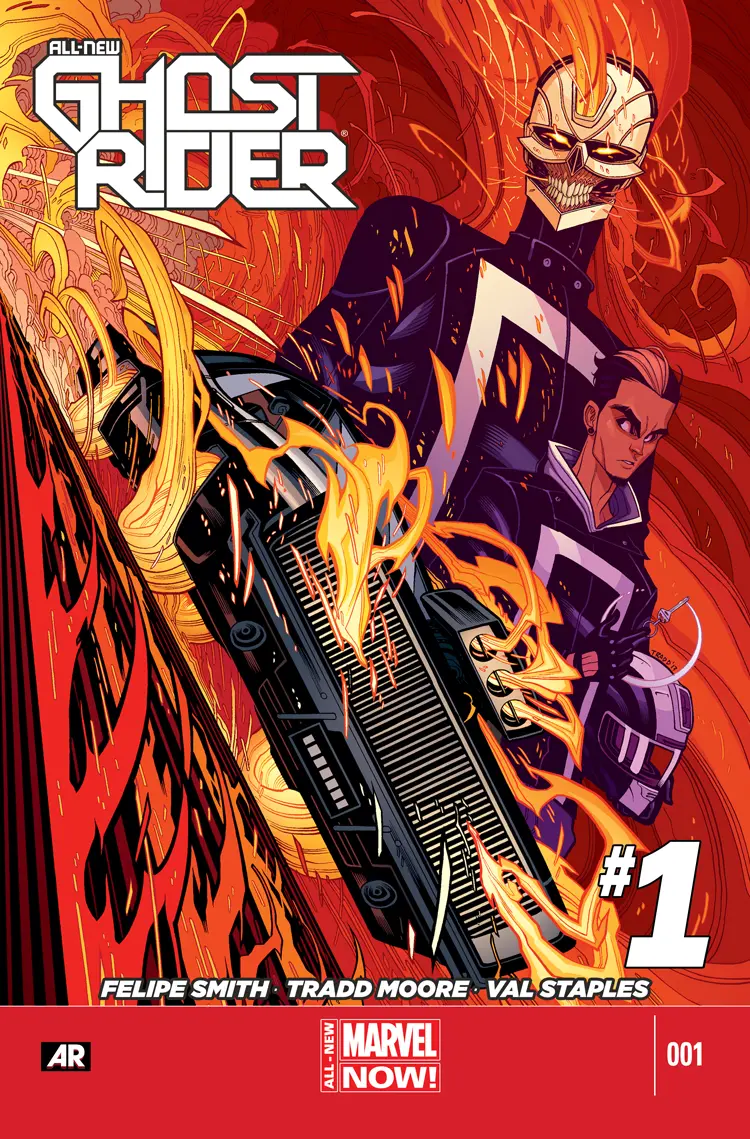
All-New Ghost Rider #1 Robbie ReyesThe motorcycle becomes a muscle car.
Felipe Smith and Tradd Moore introduce East Los Angeles teenager Robbie Reyes, his brother Gabe and the demonic Dodge Charger. Robbie's possession begins with the ghost of Eli Morrow rather than the conventional Johnny Blaze formula.
Key reading · All-New Ghost Rider #1–12 · Ghost Rider (2016) #1–5
-
The branches

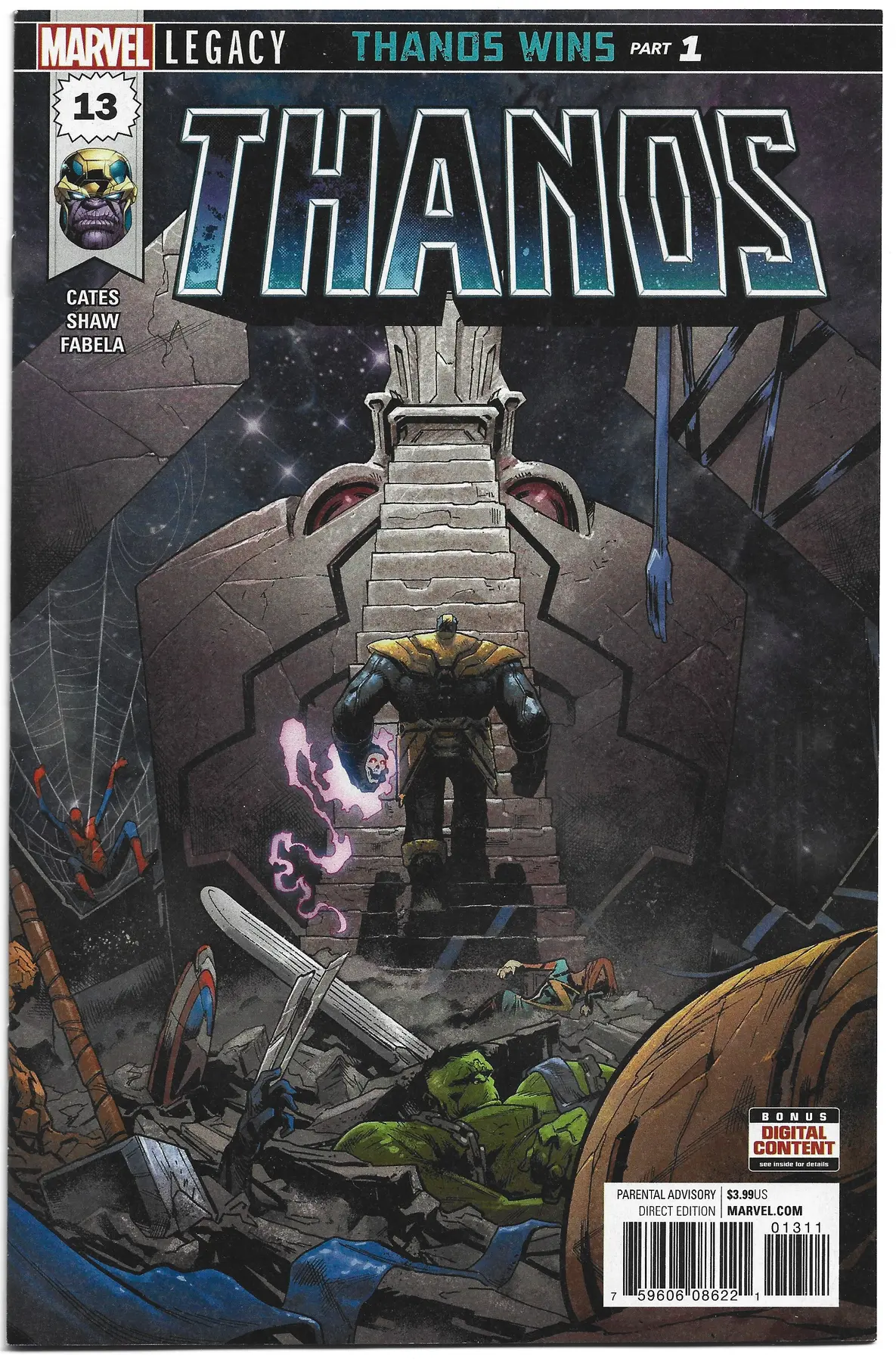
Thanos #13 · 2017 Cosmic and infernalThe Rider reaches space—and rules Hell.
Thanos #13 introduces Cosmic Ghost Rider, later revealed as a future Frank Castle. On Earth, Damnation pushes Johnny towards becoming King of Hell while Danny and Robbie continue to carry separate branches of the legacy.
Key reading · Thanos #13–18 · Damnation · Ghost Rider (2019)
-
The current road

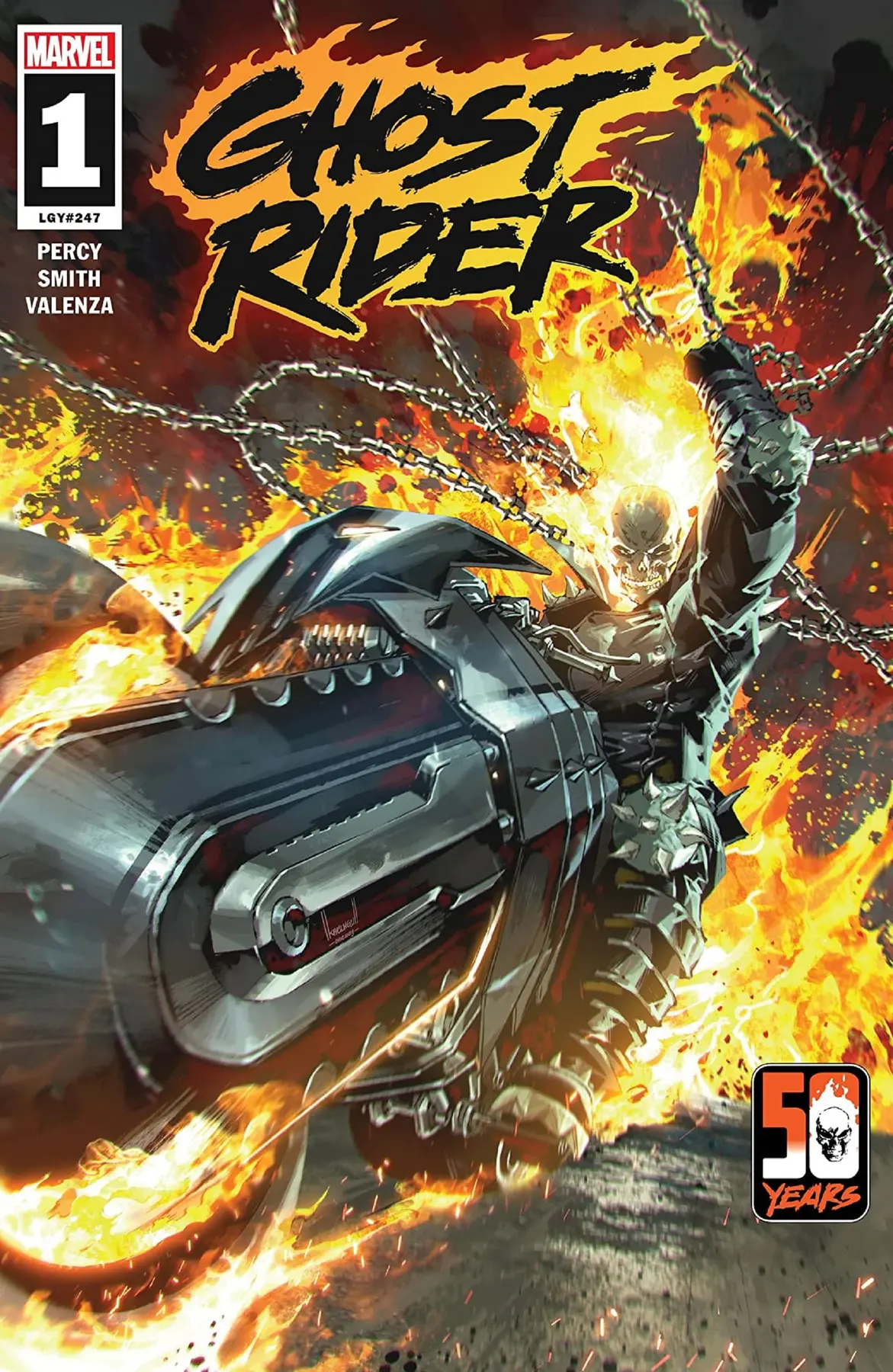
Ghost Rider #1 · 2022 Johnny, Danny and RobbieRoad horror returns before the Riders reunite.
Benjamin Percy and Cory Smith restore Johnny's cursed-Americana atmosphere in a 21-issue run, followed by Final Vengeance. Sabir Pirzada's six-issue Spirits of Vengeance (2024–25) then leads into the five-issue Spirits of Violence, which ended in February 2026. As of September 2026 there is no verified Ghost Rider solo ongoing; Robbie Reyes remains active with the new Midnight Sons in Marc Spector: Moon Knight.
Key reading · Ghost Rider (2022) #1–21 · Final Vengeance #1–6 · Spirits of Vengeance (2024) #1–6 · Spirits of Violence #1–5
The decisive change
1973: The road leads out of Marvel Spotlight.
Johnny Blaze's seven-issue tryout in Marvel Spotlight proved that the supernatural biker could support more than a striking origin. Ghost Rider #1 gave him his first self-titled ongoing, a road of his own and space for the curse to evolve.
The series ran for 81 issues across a decade. Its tone shifted from superhero melodrama to occult road story, while writers and artists steadily built the Zarathos mythology. This is the real beginning of Ghost Rider as a lasting comic-book line rather than a one-off horror concept.
Creators who shaped the character
Six teams that kept the wheels turning.
Ghost Rider's visual identity looks simple—a skull, flames and a vehicle—but each major era changed what the curse meant, who could carry it and how large the mythology could become.
Gary Friedrich, Roy Thomas & Mike Ploog
Defining era · 1972–75What changed. They converted a Western name into a modern horror icon: stunt rider Johnny Blaze, a desperate bargain, a flaming skull and a motorcycle that looked dangerous before the supernatural elements even appeared.
Why it matters. Every later Rider responds to this foundation, whether by inheriting it, revising it or rejecting parts of it. Ploog's raw, kinetic line made the transformation feel frightening rather than polished.
Michael Fleisher & Don Perlin
Key overlap · 1979–81What changed. Fleisher's run from #36–66 pushed Johnny towards harsher occult melodrama. Perlin—already the title's regular penciller—gave most of their overlapping issues a muscular, grounded road-horror texture.
Why it matters. Their shared issues made the curse feel like a continuing supernatural journey rather than a repeated transformation gimmick, while Perlin's motorcycles, flames and roadside settings kept the horror physical and believable.
Howard Mackie, Javier Saltares & Mark Texeira
Defining era · 1990–94What changed. Danny Ketch arrives with a cleaner mystery, a spiked leather silhouette, a transforming motorcycle, the chain and the Penance Stare. Saltares supplies the structure; Texeira's heavy inks make the Rider feel carved out of smoke and metal.
Why it matters. This is the version that made Ghost Rider a 1990s franchise and powered the Midnight Sons line. Many details now treated as universal Ghost Rider traits begin with Danny's era rather than Johnny's.
Jason Aaron & collaborators
Defining era · 2008–10What changed. With artists including Roland Boschi, Tan Eng Huat and Tony Moore, Aaron reveals that Spirits of Vengeance have appeared across cultures and eras, then turns Heaven and Hell into competing forces in a violent family saga.
Why it matters. The run makes Ghost Rider a worldwide mythology without losing the dirty-road energy. It also gives Johnny and Danny distinct roles inside the same larger story.
Felipe Smith & Tradd Moore
Defining era · 2014–15What changed. Robbie Reyes brings the story to East Los Angeles, trades the Hellcycle for a muscle car and anchors the drama in his responsibility for his brother Gabe. Moore draws speed as violent distortion rather than conventional superhero motion.
Why it matters. Robbie proves the concept can change host, city, culture, vehicle and supernatural rules while still reading instantly as Ghost Rider.
Benjamin Percy & Cory Smith
Defining era · 2022–24What changed. Percy and Smith return Johnny to cursed Americana: small towns, bodily corruption, unreliable memory and a Spirit that is as frightening to its host as it is to the guilty.
Why it matters. The 21-issue run reconnects the modern title to the wandering-horror atmosphere of the Bronze Age while still making room for Wolverine, Danny Ketch and a larger contemporary Marvel line.
The five defining comics
Five issues that explain Ghost Rider.
These are not simply the most valuable books. Together they show the decisive changes in the property: supernatural origin, solo status, new host, modern reinvention and the point where the mantle escapes Earth entirely.
Stories and crossovers
Then follow the wider road.
Marvel Spotlight #5–11
The complete Johnny Blaze tryout: the bargain, the transformation and the proof that the new supernatural Rider could carry an ongoing story.
Ghost Rider #28–34, then #36–66
Begin with Roger McKenzie and Don Perlin, then continue into Michael Fleisher's long writing stretch. Perlin draws most—but not every—issue through #60, so the art team changes within this block.
Ghost Rider (1990) #1–25
Danny Ketch's foundation: mystery, chain, Penance Stare and the visual language that made the character a 1990s success.
Rise of the Midnight Sons
A six-part launch sequence beginning in Ghost Rider #28 and spreading through five connected supernatural titles.
Aaron's Ghost Rider → Heaven's on Fire
Read issues #20–35 of the 2006 series, then the six-issue finale for a complete modern Johnny-and-Danny epic.
All-New Ghost Rider #1–12
Robbie Reyes, Gabe and the Hell Charger form the cleanest modern entry point for readers who want a new host and setting.
Hearts of Darkness & The Dark Design
Ghost Rider, Wolverine and Punisher collide with Blackheart in two compact prestige-format stories.
The Midnight Sons events
Rise of the Midnight Sons, Midnight Massacre and Siege of Darkness turn Danny's success into a full supernatural line.
Circle of Four
Alejandra joins Venom, Red Hulk and X-23 against Blackheart in a crossover that shows the Rider working inside a very unlikely team.
Damnation & Weapons of Vengeance
The first sends Johnny towards the throne of Hell; the second reconnects Ghost Rider and Wolverine in a modern four-part hunt.
Part one of Rise of the Midnight Sons and the gateway to Marvel's 1990s supernatural line.
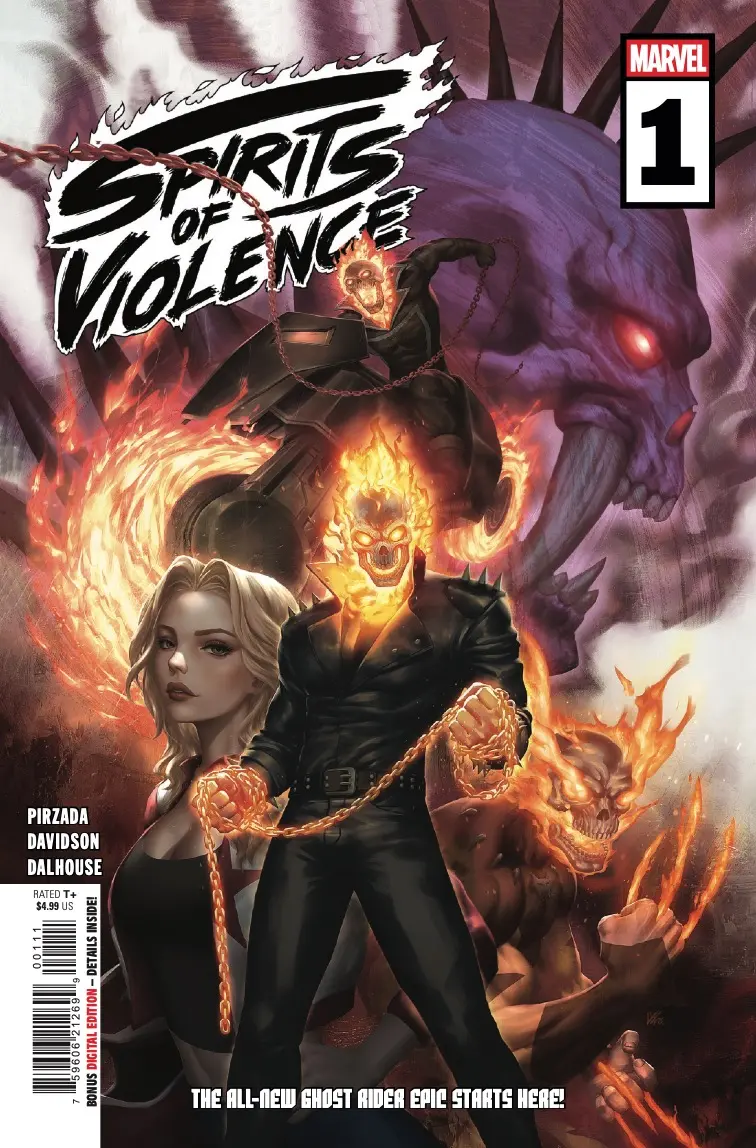
A modern ensemble story bringing Johnny, Danny and other Riders back onto the same road.
Collector's route
How to build a Ghost Rider shelf.
A satisfying Ghost Rider collection does not need to start with Marvel Spotlight #5. The history divides naturally by Rider, which makes it easy to build one coherent section before moving towards the major keys.
Choose the Rider
Begin with Johnny Blaze, Danny Ketch or Robbie Reyes. Their titles, supporting casts and visual identities are distinct enough to make each a satisfying collection on its own.
Start with an accessible anchor
Ghost Rider #1 from 1990 and All-New Ghost Rider #1 are natural anchors before the premium 1972 and 1973 debut books.
Build a run or crossover
Choose a focused block such as Danny's first 25 issues, Rise of the Midnight Sons, Jason Aaron's run or Robbie's original twelve issues.
Check the volume carefully
Ghost Rider has many identically numbered first issues. Verify the year, printing, cover and whether a book is an original issue, reprint or modern facsimile before buying.
Cover art spotlight
Three ways to make the flames move.
A Bronze Age battle cover from the Comic Agent collection, balancing supernatural spectacle with clear storytelling.
A restrained first look at Danny Ketch's angular motorcycle and darker, metallic Rider.
Extreme motion, graphic flames and the Hell Charger announce that Robbie is a genuine reinvention.
Cover artwork and characters © Marvel and their respective creators. Images are reproduced in direct editorial context for identification, commentary and review.